Running the Restaurant
Restaurant Technology: What You Need, by Job
Restaurant technology is easier to choose when you start from the job, not the brand. What to set up first, what each tool does, what to ask before you sign, how card fees and delivery commissions really work, and the stack by type of restaurant.
Restaurant technology is a set of tools that each do one job: take the order, take the payment, get the order to the guest, schedule the team, count the stock and keep the books. Set up the first three (a sales record, card payments and a weekly cost check) before anything else, then add a tool only when a specific job is costing you time or money.
We sell nothing, earn nothing from any link here and do not rank products. Where we quote a company's prices or rules, we quote its own published page, with the date we read it.
What to set up first
Set up, in this order: a way to record sales, a way to take cards, and a weekly habit of counting stock and labor. Everything else builds on those three.
- Sales record and POS. Every other number (food cost, labor percentage, taxes) starts here.
- Card payments. Most restaurants need to accept cards. Understand the fees before you sign (see "Taking payment" below).
- A weekly count and a weekly cost check. A notebook or spreadsheet is enough. See prime cost for the weekly routine.
- Scheduling and time clock. Labor is a cost you can adjust week to week, so it pays to schedule against expected sales.
- Online ordering and delivery. Add these when your kitchen can handle the extra orders without slowing the dining room.
- Automation. Add it last, to fix a specific bottleneck, not to look modern.
Point of sale (POS)
A POS is the system where orders are entered and paid for, and its most useful output is the sales data every other decision depends on. It usually has a screen or tablet for staff, a card reader, a receipt printer or digital receipts, a cash drawer and software that connects them.
What a POS does
| Job | What it means for you |
|---|---|
| Take orders | Staff enter items and modifiers (no onions, extra sauce) once |
| Route orders | Tickets print or appear in the kitchen, bar or both |
| Take payment | Cash, cards, split checks, tips, refunds |
| Record sales | Sales by item, hour, day and staff member |
| Report | The numbers behind food cost and prime cost |
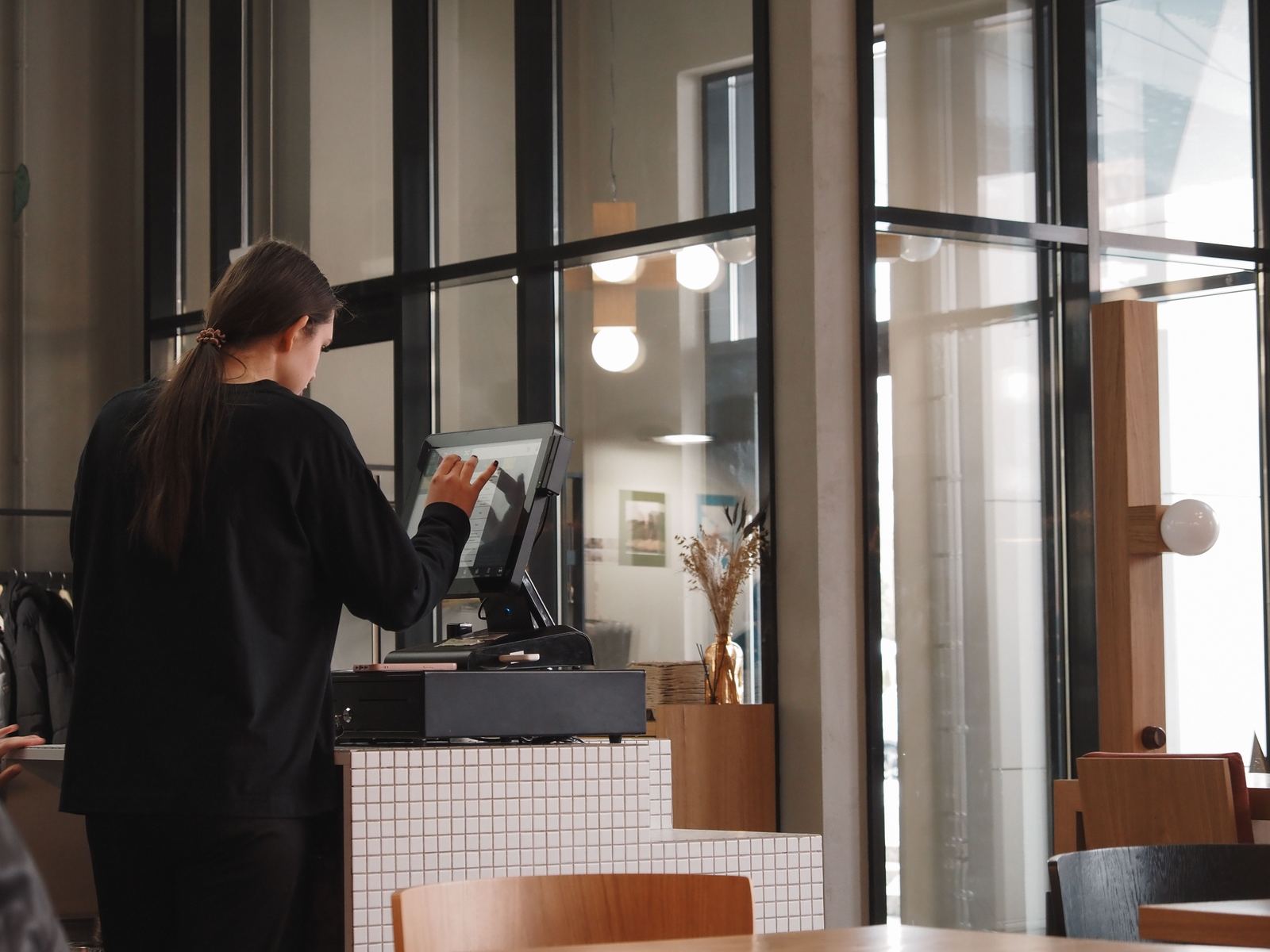 A café employee entering an order on a touchscreen register
What it typically costs to run
We could not find a primary source (a government, trade association or company fee page) that gives a fair industry-wide price for a restaurant POS, and vendor blog posts copy each other, so we give the cost components instead. Ask every provider for each line in writing.
| Cost component | What to ask |
|---|---|
| Hardware | Buy, lease or rent? How many terminals, printers and card readers do you need to run your busiest hour? |
| Software subscription | Monthly price per terminal or per location? Which features cost extra (online ordering, inventory, loyalty, reporting)? |
| Card processing | Rate and fees per transaction? Is it a flat rate or interchange plus a markup? |
| Setup, training and support | Is menu entry included? Is support available on a Friday night? |
| Add-ons and integrations | What does connecting to delivery apps, accounting or scheduling cost? |
What to ask before you sign
- How long is the contract, and what does it cost to leave? Ask for the early termination terms in writing.
- Who owns the hardware when the contract ends, and what happens if you stop paying the subscription?
- Can you export your data? Ask for sales, menu and customer data in a standard file (such as CSV), and whether there is a fee. Without it, switching later means starting over.
- Is card processing tied to the POS? If you must use the POS company's processor, you cannot shop for a better rate later.
- What happens when the internet drops? Ask whether you can still take orders and payments, and when the offline sales sync.
- What are all the fees beyond the monthly price: setup, hardware, extra locations, extra terminals, chargebacks, and rate increases after the first term?
- Is any hardware on a lease, and with whom? A lease can be a separate contract with a different company that you cannot cancel early, even if you leave the POS or the processor. Ask whether any contract renews automatically and what compliance fees apply.
Food trucks and coffee shops
Both need what any restaurant needs, plus two things that matter more than any feature list:
- Offline mode. A truck at a festival or a shop with unreliable Wi-Fi cannot stop selling when the connection drops. Ask exactly what works offline (orders, card payments, or only cash) and how it syncs.
- Mobile, compact hardware. A truck needs a small, battery-backed setup that fits a service window. A coffee shop needs speed at the counter and a fast way to split orders and handle modifiers.
Taking payment
A card payment costs you a percentage of the sale made up of several layers, and what you negotiate is the merchant discount your processor quotes. Understanding the layers lets you compare quotes properly.
How card fees work
| Layer | Who gets it | What it is |
|---|---|---|
| Interchange | The bank that issued the guest's card | A transfer fee between the acquiring bank and the issuing bank (Visa's description) |
| Network fees | The card network | Fees for processing the transaction (the Federal Reserve measures these separately from interchange) |
| Processor markup | Your processor or payment provider | What the company that serves you adds on top |
Visa's own page says it uses interchange reimbursement fees "as transfer fees between acquiring banks and issuing banks," that merchants do not pay these fees directly, and that merchants "negotiate and pay a 'merchant discount' to their financial institution that is typically calculated as a percentage per transaction." In other words, you see one rate, and inside it are the layers above.
For scale, the Federal Reserve's 2023 data collection on debit card transactions reports an average network fee of $0.129 per debit transaction in 2023, counting fees paid by card issuers as well as by merchants' banks. It covers debit only, so treat it as a data point on the network layer, not your total cost.
A quote is usually built one of three ways: a flat rate (one percentage and a fixed fee for everything), interchange plus (the actual interchange and network fees passed through, plus a stated markup), or tiered pricing ("qualified", "mid-qualified" and "non-qualified" rates). Tiered quotes are the hardest to compare: ask what share of your sales falls in each tier, or ask for an interchange-plus quote alongside. Ask which one you are being offered. Then ask for your effective rate: total card fees for a month divided by total card sales for that month.
The arithmetic, with a made-up rate: if card sales are $30,000 a month and all-in card fees are 3%, you pay $900 a month, or $10,800 a year. Each 0.1 percentage point you negotiate away is worth $30 a month.
Surcharges and cash discounts
You may be able to pass card costs to guests, but card-network rules and state law both apply, and the rules differ between a surcharge and a cash discount.
What Visa publishes for US merchants (its Q&A, version dated February 15, 2024):
- Notify your acquirer at least 30 days before you start surcharging.
- Surcharge credit cards only. Debit and prepaid cards cannot be surcharged.
- Limit the amount to your merchant discount rate (MDR) for that card, or 3%, whichever is lowest.
- Disclose it as a separate charge on the receipt and post signs at the entrance and the point of sale.
Visa also says some state laws prohibit or limit surcharging, and that as of February 15, 2024 it understood Connecticut, Maine, Massachusetts, Oklahoma and Puerto Rico prohibit it, while Colorado, Minnesota, New Jersey and New York have requirements for it. Visa notes that this understanding may contain errors or be out of date and is not legal advice. Check your state's current law, including any rules on mandatory fees and how menu prices must be shown, and ask your processor, before you add a surcharge. Mastercard publishes its own surcharge rules for merchants. Read them too: this page quotes Visa's rules only.
A cash discount is different. Visa's Q&A says a merchant may offer a discount for paying by a method other than a Visa card, but only if prices are displayed as the card price only, or the card and cash price side by side, and the final bill is not made by adding a fee for paying by card. A card fee added at the end "may be treated as a surcharge and subject to Visa's surcharge rules."
Online ordering and delivery apps
On published plans from one major delivery app, commission runs from 15% to 30% of the order subtotal for delivery, so work out what each channel leaves you before you decide whether to join. Other apps set their own rates.
The real cost of a third-party order
These are DoorDash's own published merchant plans, as shown on merchants.doordash.com in October 2026. Plans change, so check the current page.
| Plan | Delivery commission | Pickup commission |
|---|---|---|
| Basic | 15% | 6% |
| Plus | 25% | 6% |
| Premier | 30% | 6% |
DoorDash says you pay "a percentage of each order's subtotal," with no activation, subscription or payment processing fee, and that the commission covers listing and marketing, Dasher logistics, customer support and credit card processing.
Two things can change the picture. Some cities cap what apps may charge: New York City caps delivery fees at 15% of the purchase price of each online order, transaction fees at 3%, basic service fees at 5% and enhanced service fees at 20%, with limited exceptions. And commission is not the only deduction: ask what you pay for promotions and ads, and how refunds for missing or wrong items are charged back to you.
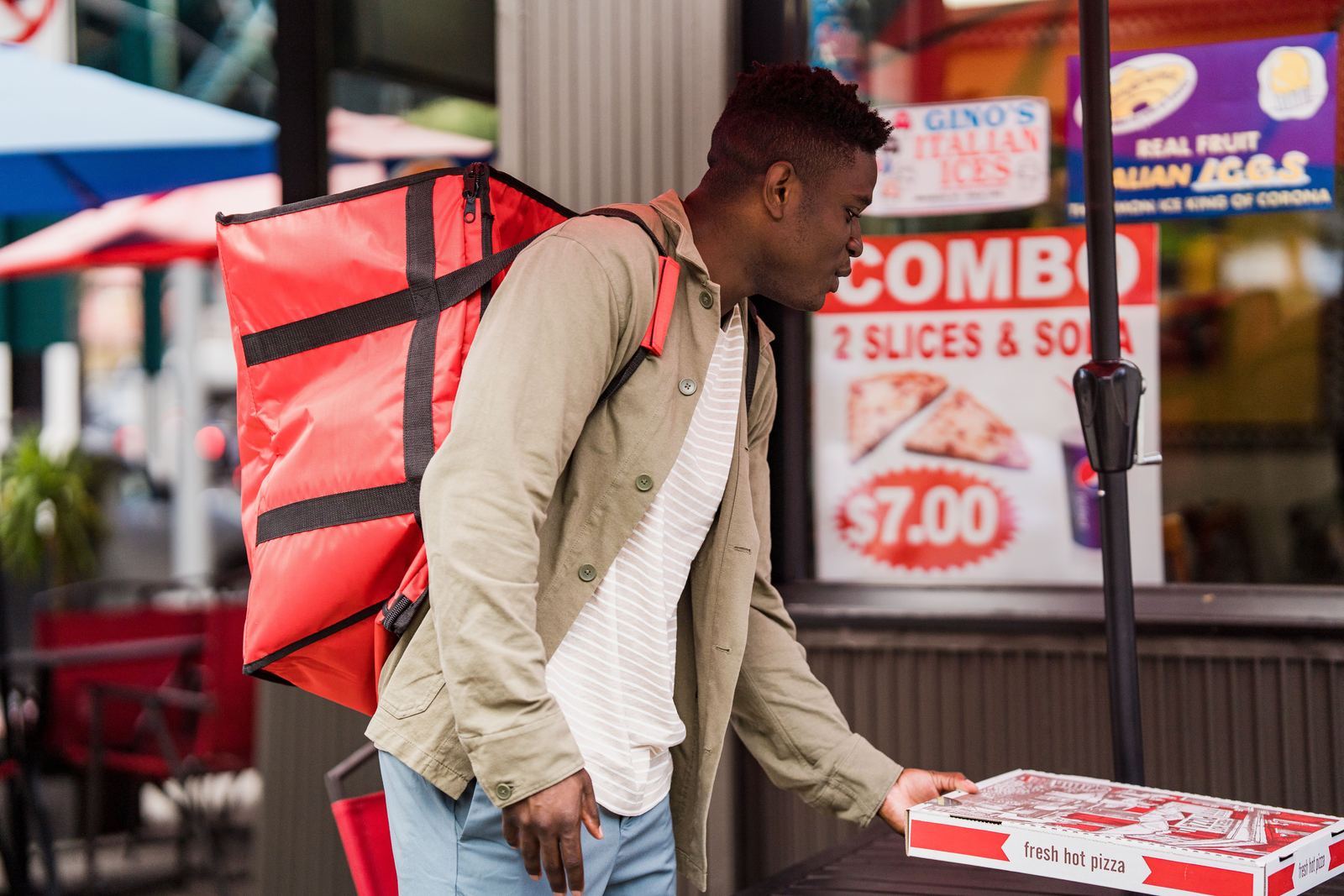 A delivery courier with an insulated bag collecting a pizza order from a restaurant
A worked example. The figures below are illustrative, made up to show the math, not a real restaurant. One $40 delivery order at a restaurant with 31% food cost and 34% labor (the same illustrative restaurant as our prime cost example), on a plan with a 25% commission:
| Line | Amount |
|---|---|
| Order subtotal | $40.00 |
| Food and packaging cost (31%) | $12.40 |
| Commission (25% of $40) | $10.00 |
| Labor (34%) | $13.60 |
| Left for rent, utilities, insurance, everything else and profit | $4.00 |
The same order at a 15% commission leaves $8.00. At 30% it leaves $2.00. At the 6% pickup rate it leaves $11.60. The same order through your own ordering, paying an illustrative 3% in card fees ($1.20), leaves $12.80. This example applies average labor to every order; an extra order your existing team can handle costs you less labor than that, so your real gap may be smaller or larger. Your own numbers decide: find your food cost and labor percentages first, then see what is left at each commission rate.
Delivery apps argue that some orders are incremental, from guests who would not otherwise have ordered. Only your own sales data can show whether that is true for you. You can also set different prices for delivery orders.
First-party ordering
First-party ordering means guests order from your own website or link, so you keep the sale and the guest relationship.
Some providers charge no commission on direct orders: DoorDash, for example, publishes "0% commission on direct orders" for its own online ordering, with standard payment processing fees and delivery fees paid by the guest (October 2026). Card processing still applies whichever provider you use. Ask each provider for all its fees in writing.
Whichever route you use, check that:
- Online orders flow into your POS so staff do not re-key them.
- Menu prices and availability update in one place.
- You can export guest contact details you are allowed to use. That list feeds email marketing.
Scheduling, time clocks and tips
Scheduling software helps you match staff hours to expected sales, and the tip rules that apply to it come from federal and state law, not from the software. What the tools do:
| Tool | What it does for you |
|---|---|
| Scheduling | Builds the week's shifts, handles swaps and time-off requests, sends the schedule to staff |
| Time clock | Records actual hours worked, often from a phone or the POS |
| Labor reports | Compares scheduled and actual hours to sales, so you can see labor as a percent of sales |
| Tip tools | Record tips by shift and calculate each person's share under your pool rules |
Labor is part of prime cost, so the report you want is labor cost against sales by day and hour.
Tip pooling basics, as the Department of Labor states them
This is a summary of what the US Department of Labor says, not legal advice. Check your state's rules and consult your state labor department or a qualified adviser before you set up or change a tip pool.
- Cash wage. "An employer must pay a tipped worker at least $2.13 per hour under the FLSA," and the maximum tip credit is currently $5.12 per hour (the $7.25 federal minimum wage less the $2.13 cash wage). If tips plus the cash wage fall short of the minimum wage in a workweek, the employer must make up the difference. (Fact Sheet #15.)
- Tell staff before you take a tip credit. The federal regulation says an employer cannot take the tip credit unless it has informed its tipped employees in advance, including the cash wage it pays and the amount of tip credit it claims (29 CFR 531.59(b)).
- Who may be in the pool if you take a tip credit. The employer "can require tipped employees to contribute tips only to a tip pool which is limited to employees in occupations in which they customarily and regularly receive tips, such as waiters, bellhops, counter personnel (who serve customers), bussers, and service bartenders." (Fact Sheet #15.)
- If you do not take a tip credit. The federal tip pooling regulation, 29 CFR 531.54(d), says an employer that pays the full minimum wage and takes no tip credit may include dishwashers, cooks and other employees who do not customarily receive tips in a mandatory pool.
- Owners and managers. "Regardless of whether an employer takes a tip credit, the FLSA prohibits employers from keeping any portion of employees' tips for any purpose, whether directly or through a tip pool." Who counts as a manager or supervisor depends on duties, not job title: under 29 CFR 531.52(b)(2) it is anyone whose duties match those of an executive employee in the federal overtime rules, which also covers owners with at least a 20% stake who actively manage. A manager or supervisor "may keep only those tips that they receive directly from a customer for the service they directly and solely provide." (Fact Sheet #15.)
- Paying tips out. If you collect and redistribute tips, 29 CFR 531.54(b)(2) says you must fully distribute them no later than the regular payday for the workweek in which they were collected, or as soon as practicable after it if you cannot work out amounts before payroll.
- States can be stricter. "When state law differs from the federal FLSA, an employer must comply with the standard most protective to employees." The Department of Labor also publishes a page of state tipped minimum wages (last updated July 1, 2026).
Official sources: Fact Sheet #15, tip regulations summary, 29 CFR 531.54 and state tipped minimum wages.
Inventory and purchasing
Inventory tools help you count what you have, order what you need and see how much of your sales went into food and drink.
The open textbook Basic Kitchen and Food Service Management (BCcampus) describes two basic record-keeping methods:
- Perpetual inventory: "a running balance of what is on hand." It can show the reorder point and the par stock, "how much of the product should ideally be on hand at a given time." In small operations it is usually kept only for expensive items, because keeping the records costs time.
- Physical inventory: a count of everything in storage. "To be an effective control, physical inventory should be taken at least monthly."
Keeping both helps: a mismatch between the count and the running balance is your prompt to look for waste, theft or a recording error.
How inventory feeds your numbers: the textbook's formula is cost of food = opening inventory + purchases − closing inventory (BCcampus, "Monthly Food Costs"), and the same formula gives cost of goods sold for drinks and packaging. So a consistent count is what makes food cost trustworthy. Our guides show where it goes next: price each dish with the food cost calculator, then add labor to see prime cost.
What to look for in a tool: it records invoice prices, lets you set par levels by item, counts by storage location, and ideally shows theoretical usage (from sales and recipes) against actual usage so you can see waste. The last one only works if your recipes are kept up to date.
Bookkeeping and accounting
Bookkeeping is recording every dollar in and out in a consistent way, so you know your numbers and can file taxes. The habit matters more than the tool.
The IRS (Publication 583) says supporting documents such as sales slips, invoices, receipts and deposit slips support the entries in your books and your tax return, and that "generally, it is best to record transactions on a daily basis." It lists cash register tapes, bank deposit slips and credit card charge slips among the documents that show gross receipts.
A practical rhythm:
| When | What to do |
|---|---|
| Daily | Reconcile the day's POS sales report to the cash counted and card batch |
| Weekly | Count inventory, total purchases, work out cost of goods sold and labor, and calculate prime cost |
| Monthly | Reconcile bank and card accounts, review the profit and loss statement, set aside sales and payroll taxes and pay them on the schedule the IRS and your state give you (federal payroll tax deposits follow either a monthly or a semiweekly schedule), and take a full inventory count |
| Quarterly or yearly | Review pricing, contracts and fees; give your accountant clean records |
For what the profit and loss statement should show and what a healthy result looks like, see restaurant profit margin. Ask your accountant which POS exports and accounting integrations they can work with before you buy either.
Automation
Automate the repetitive steps between your guest and your kitchen first, because that is where a missed ticket or a re-keyed order costs you money.
 Cooks working the line in an open restaurant kitchen
| Automation | What it does | Worth it first when |
|---|---|---|
| Online ordering into the POS | Orders from your site or apps arrive as normal tickets | Staff are re-typing online orders, or tablets are piling up at the counter |
| Kitchen display system (KDS) | Shows tickets on a screen instead of printing them, with timers | Printed tickets get lost, or you want to see ticket times per station |
| Scheduling from sales forecasts | Suggests staffing levels from past sales | You have a year or more of sales history and your labor swings from week to week |
| Automatic inventory ordering from par levels | Drafts purchase orders from counts | You order the same items every week and spend hours on it |
| Receipt and invoice capture | Reads supplier invoices into your books | You enter many invoices by hand each month |
A sensible order: order flow first, then labor, then purchasing. None of it works on bad data, so keep menu items, recipes and prices clean in the POS before you switch anything on. If the menu itself needs work first, see restaurant menu design and menu engineering.
The stack by type of restaurant
What you need first depends on how you serve, so use this table as a starting point and adjust it to your own busiest hour.
| Type | Get first | Can wait |
|---|---|---|
| Planning to open | A budget sheet and a menu; decide your service style; price card processing | Buying the POS: decide it once the menu, layout and service style are fixed, because those decide which features you need. Online ordering, automation |
| Food truck | Mobile POS that works offline, card reader, a simple way to post your location | Scheduling software, inventory software, a kitchen screen |
| Café or quick-service | Fast counter POS, card payments, online ordering into the POS, a way to handle modifiers | Advanced inventory, forecasting tools |
| Full-service independent | POS with table management and split checks, scheduling and time clock, weekly counts, bookkeeping | Online ordering (unless you want takeout), kitchen screen if tickets are fine |
| Bar | POS with tabs and quick entry of drinks by pour size, counts by the bottle, tip handling | Online ordering, scheduling forecasts |
| Multi-site | Reporting that compares the same numbers across sites, central purchasing, shared menu control | Heavy customization before the single-site basics are consistent |
Reservations and email
Reservations and email are two ways to bring guests back, and both are worth setting up once the basics above are running.
- Reservations. If you take bookings, ask how the system handles no-shows and deposits, and whether you can export your guest list. Ask the same ownership and data export questions as for the POS.
- Email. Your online ordering and reservation tools are where the guest list comes from. Keep it clean, with permission, and use it. See email marketing.
- Loyalty. A loyalty program needs the POS to recognize returning guests. See loyalty programs.
Sources
- Visa, "U.S. Merchant Surcharge Q and A" (version 02152024): surcharge rules, cap, state laws, cash discounts.
- Visa, "Credit Card Processing Fees & Interchange Rates": interchange and merchant discount.
- Board of Governors of the Federal Reserve System, "2023 Interchange Fee Revenue, Covered Issuer Costs, and Covered Issuer and Merchant Fraud Losses Related to Debit Card Transactions" (last update January 7, 2026): network fee per debit transaction.
- DoorDash for Merchants, "DoorDash Merchant Fees & Pricing" (read October 2026): plan commission rates and what they cover.
- DoorDash for Merchants, "Online Ordering" (read October 2026): commission-free direct orders, processing fees.
- US Department of Labor, Wage and Hour Division, "Fact Sheet #15: Tipped Employees Under the Fair Labor Standards Act".
- US Department of Labor, "Tip Regulations Summary" and "Minimum Wages for Tipped Employees" (last updated July 1, 2026).
- New York City Department of Consumer and Worker Protection, "Requirements for Delivery Apps" (read October 2026): fee caps.
- eCFR, "29 CFR 531.52" (managers and supervisors) and "29 CFR 531.59" (tip credit notice).
- eCFR, "29 CFR 531.54, Tip pooling".
- BC Cook Articulation Committee, Basic Kitchen and Food Service Management (BCcampus, CC BY 4.0), "Basic Inventory Procedures" and "Monthly Food Costs".
- Internal Revenue Service, "Publication 15, Employer's Tax Guide": monthly and semiweekly deposit schedules.
- Internal Revenue Service, "Publication 583, Starting a Business and Keeping Records".
Frequently asked questions
What technology does a restaurant need to open?
At minimum: a way to take and record sales (a POS or a simple register that exports sales), a way to accept cards, and a way to track what you buy and what you pay staff. Everything else, such as online ordering, a kitchen display or scheduling software, can wait until the basics are running and you know which job is costing you the most time or money.
What is a POS system in a restaurant?
A POS (point of sale) system is the software and hardware where orders are entered and paid for. It records every sale, sends orders to the kitchen or bar, takes payment, and produces the sales reports you use for food cost, labor and tax. Ask whether it connects to your card processing, online ordering and inventory.
How much does a third-party delivery order really cost?
On DoorDash's own published plans (October 2026), delivery orders carry a commission of 15%, 25% or 30% of the order subtotal depending on the plan, and pickup orders carry 6%. On a $40 subtotal that is $6.00 to $12.00 per order before the food, packaging and labor that went into it. Other apps set their own rates, and some cities cap them: New York City caps delivery fees at 15% of the purchase price. Check the current terms before you decide, because plans change.
Can a restaurant charge customers extra for paying by card?
Sometimes. Visa's published rules allow a surcharge on credit cards only, capped at the lower of your merchant discount rate or 3%, with 30 days' notice to your processor and clear disclosure. Several states prohibit or restrict surcharging, so check your state and your processor before you add one.
Can managers share in the tip pool?
Under federal rules, no. The Department of Labor says employers and managers or supervisors may not keep employees' tips, including through a tip pool, and a manager may keep only tips received directly from a customer for service they provided themselves. Who counts as a manager or supervisor depends on their duties, not their job title, and owners who actively manage the business can count too. Your state may have stricter rules, so check with your state labor department.